 A new perspective on wine.
 Japan, beyond the familiar.
 Stories from Japan.


05 · Winegrowing in Japan
The art of working with nature
Rain has more than one season
Water is part of the planning for every season in Japan’s vineyards. Yet the familiar description of a “rainy Japan” conceals the crucial differences between seasons and regions. The Japan Meteorological Agency describes the influence of the Baiu front in early summer: rainfall increases across much of the country, with Hokkaidō explicitly identified as the exception. In September, autumn rain fronts and typhoons become sources of rainfall. These are different weather patterns that may also coincide with different stages of vine development.
A particular vintage makes this separation in time tangible. For its Yamanashi Koshu 2021, Château Mercian describes a long rainy season, subsequently more favourable weather, then more than a week of rain in August and a recovery in September. Harvest took place in September and October. This is a producer’s account of that wine and that year, rather than a harvest calendar for all Japan.
The practical inference is to consider more than annual rainfall: ask when rain arrives, how long bunches and leaves remain wet, and which stage of ripening has been reached. The rainy season is therefore not automatically the harvest season; its ending cannot guarantee a fine autumn either.
The first work happens below the surface
Water management begins in the soil. On the slopes of Tomi no Oka, Suntory describes a combination of open drainage channels and underground drains. The open channels remove surface water; perforated pipes buried in the soil collect infiltrated water and carry it out of the plot. In certain areas, vines also stand on raised planting ridges. The account presents these measures as different responses to wet growing conditions that have been tested at the estate.
The direction of the vine rows was also changed in some areas so that water could drain downhill. This assists drainage but makes the continual climbing and descending more demanding for the people doing the work. An otherwise hidden aspect of viticulture becomes visible here: sound management balances the growing site, terrain and labour. This example does not establish a general rule that Japanese vineyards should always be planted down the slope. It shows why “well drained” must describe a particular plot and its infrastructure.
A roof of vines, a wall of leaves
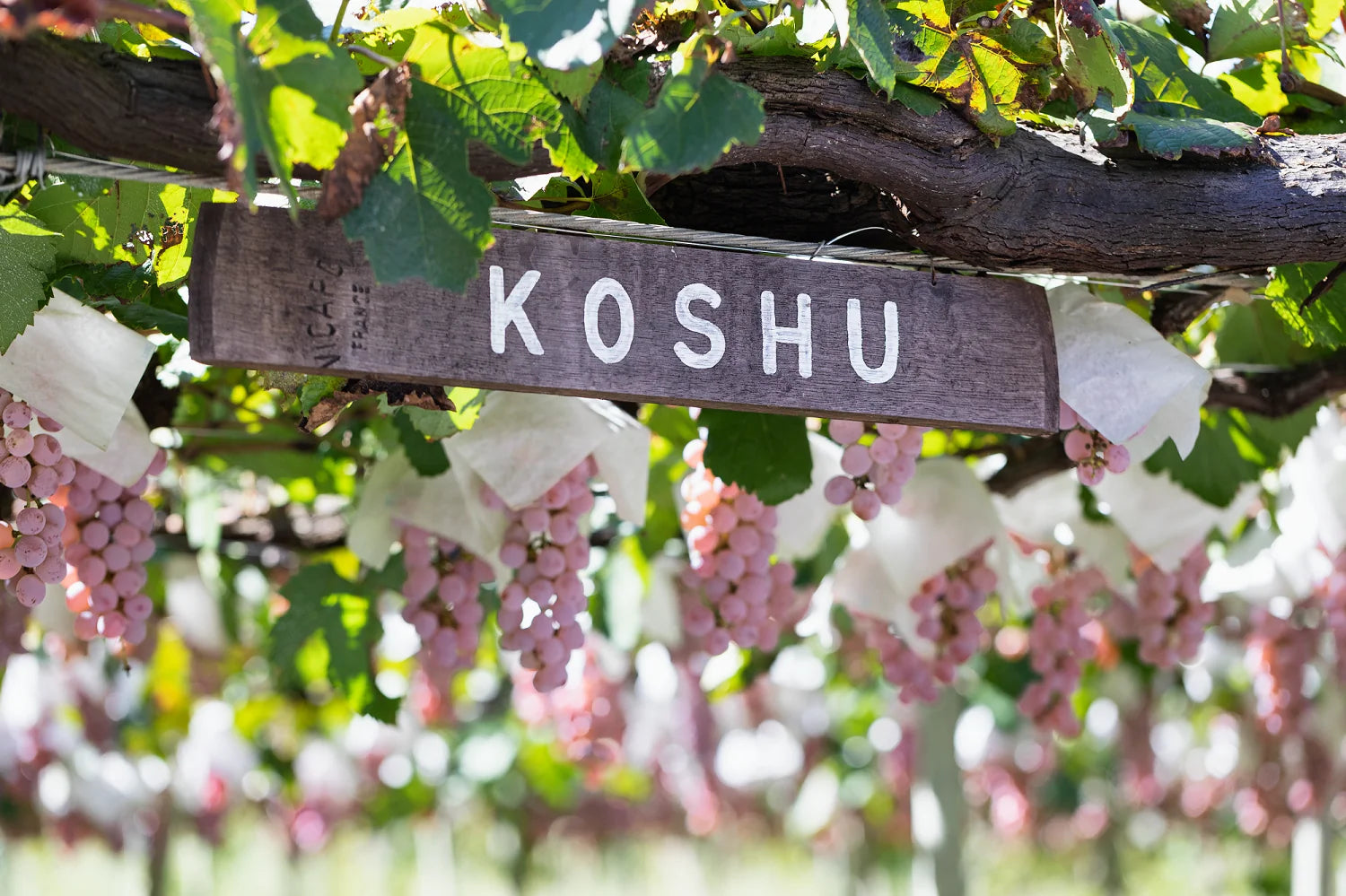
In traditional tana training, the vine spreads across a horizontal support. Japan’s National Research Institute of Brewing, NRIB, describes this expansive form as the usual system for Koshu and connects its suitability with the variety’s vigorous growth. A pergola is therefore a deliberately shaped vine architecture. Its presence alone reveals neither a quality defect nor the eventual price of the wine.
Upright trellis training is called kakine in Japan; VSP describes the vertical positioning of shoots within such a system. Fuji-san Winery documents Koshu under the VSP designation, and Grace also describes trellised Koshu. These examples show that the variety is not confined to a single form. An estate trial, however, does not demonstrate that its results can be transferred to every site.
A report from Nagano on research findings from 2015 shows why the precise form matters. The modified Smart system uses existing horizontal supports and combines spur pruning with directing new shoots to one side. In the Merlot vineyards studied in Shiojiri, average sugar levels and skin pigments were higher than in the traditional, freely structured comparison system; total working time was similar. A complementary survey of Merlot holdings found labour savings and lower yields per unit area with upright trellises. These results depend on site, management and year.
The more useful question is therefore which training system suits the vine’s vigour, variety, terrain, available labour and production goal. The appropriate form depends on these local conditions.

A small umbrella changes the microclimate
Rain protection can operate at different scales. Kasa are small shelters over individual bunches. Larger plastic structures cover a row or the fruiting zone. Nagano investigated both basic arrangements: continuous tunnels can be used where fruiting zones run in straight lines; where bunches are distributed across a freely structured pergola, the research station identifies individual shelters as an option for limiting damage from the ripe rot investigated there.
The biological relationship is more precise than “rain damages grapes”. The disease addressed in the trial, banpu-byō, spreads through spores carried by raindrops. Early covering, preferably before flowering, proved favourable with the tunnels tested. Shelters installed later over trellised bunches reduced direct wetting but left a window for infection before installation. The findings concern that disease and those systems, rather than every pathogen.
Tomi no Oka uses both larger tunnels and smaller covers over the bunches. Its own account explicitly identifies their limitation: strong wind and rain arriving at an angle can weaken protection, and smaller structures are chosen for exposed plots. Visible plastic therefore tells a story of adaptation and labour. It is neither complete weather protection nor, by itself, a statement about the quality of the eventual wine.
The balance of leaves and fruit
An open canopy results from many small decisions. Hokkaidō’s cultivation guide recommends accounting for vigour and frost risk when removing shoots, rather than removing every surplus shoot in one operation. Orderly tying improves light exposure and reduces wind breakage. Bunch thinning is intended to limit overcropping, since excessive crop load can impair fruit ripening, cane maturation and the accumulation of reserves.
The guidance on leaf removal is equally nuanced. Better airflow and access to the fruiting zone are desirable, but excessive exposure is not. The guide warns against sunburn and leaving too little leaf area. Timing and intensity depend partly on variety, row direction and weather. The common phrase “yield reduction” becomes a more precise task: bringing each vine’s crop load into balance with its growth and the season.
Figures in a regional guide remain working aids for the cultivation described. A blanket yield target for all Japan would overlook differences between varieties, training systems and sites. When assessing a wine, it is therefore useful to understand how the producer achieved its goals in that particular year.
When winter becomes part of the vineyard
Hokkaidō faces a different task in winter as well as in summer. In the west of the island, Hokkaidō Wine describes Urausu as a snowy location. Eastern Tokachi, by contrast, has comparatively little winter snow. The regional authority explains why protection beneath snow is not reliably available there for more sensitive vines. “Hokkaidō” alone is therefore not a sufficient description of the overwintering risk.
In Ikeda, vines such as Kiyomi are covered with earth for winter protection; this must be removed again in spring. The local grape and wine research institute describes the additional work as protection from cold and drying out. The desire to avoid this work encouraged the breeding of more cold-tolerant crosses using native wild vines. Yamasachi is one of the resulting varieties.
At the same time, possibilities for international varieties have expanded. A NARO study published in 2017 connected successful Pinot Noir cultivation in Yoichi and Sorachi with long-term warming and a climate shift around 1998. This is a finding defined by location and period. It does not imply that every Hokkaidō site is equally suitable, or that winter protection and careful variety selection have become unnecessary.
Harvest timing is a choice
The harvest date cannot be read from the country’s name. For Yamanashi Koshu 2020, Château Mercian specifies early September to early October; for the 2021 vintage, September to October. Even within the same wine line, the documented timings change. These are statements about the particular production or wine line, rather than universal ripening limits for the variety.
NARO’s cultivation support system combines weather data from the vineyard with observations of vine development and must analyses. These inform forecasts of development and must values that support vineyard and harvest decisions. The approach is instructive: observation, measurement and weather belong together. No single number replaces knowledge of the plot.
When reading a technical sheet, it is therefore useful to consider the information together: grape origin, vintage, harvest window, maturation and intended style. An early or late harvest acquires meaning within its particular context.
Sources & further reading · Japanese original sources
- 気象庁(JMA) · 日本の天候の概説
- シャトー・メルシャン · 山梨甲州|商品ラインアップ
- サントリー 登美の丘ワイナリー · 梅雨の登美の丘ワイナリー(その1)
- 酒類総合研究所(NRIB) · お酒のはなし ワイン2
- 富士山ワイナリー · 富士山ワイナリーについて/タイムライン
- GRACE WINE · HISTORY(沿革)
- 長野県 果樹試験場・農業試験場 · 醸造用ぶどう栽培において、片側誘引短梢せん定栽培(改良スマート仕立て)は果実の高品質化に有望である
- 長野県 農業試験場・果樹試験場・農業技術課 · 醸造用ぶどうの仕立て法による作業時間及び経営費の実態
- 長野県 果樹試験場・農業技術課 · ワイン用ぶどうにおける部分雨除けの晩腐病発生抑制効果と果実品質に及ぼす影響
- サントリー 登美の丘ワイナリー · 梅雨の登美の丘ワイナリー(その2)
- 北海道農政部 生産振興局農産振興課 · 醸造用ぶどう導入の手引(改訂第4版)後半
- 北海道ワイン株式会社 · ぶどう作り
- 北海道 十勝総合振興局 · 十勝産ワインのページ
- 池田町ブドウ・ブドウ酒研究所(TOKACHI WINE) · ブドウ栽培
- 農研機構(NARO) · (研究成果)気候変動により、北海道の代表的産地で高級ワイン用ブドウ「ピノ・ノワール」が栽培可能に
- 農研機構(NARO) · ワイン用ブドウ栽培支援情報システム利用マニュアル 第2版
